By Stephen Feinstein
A couple months
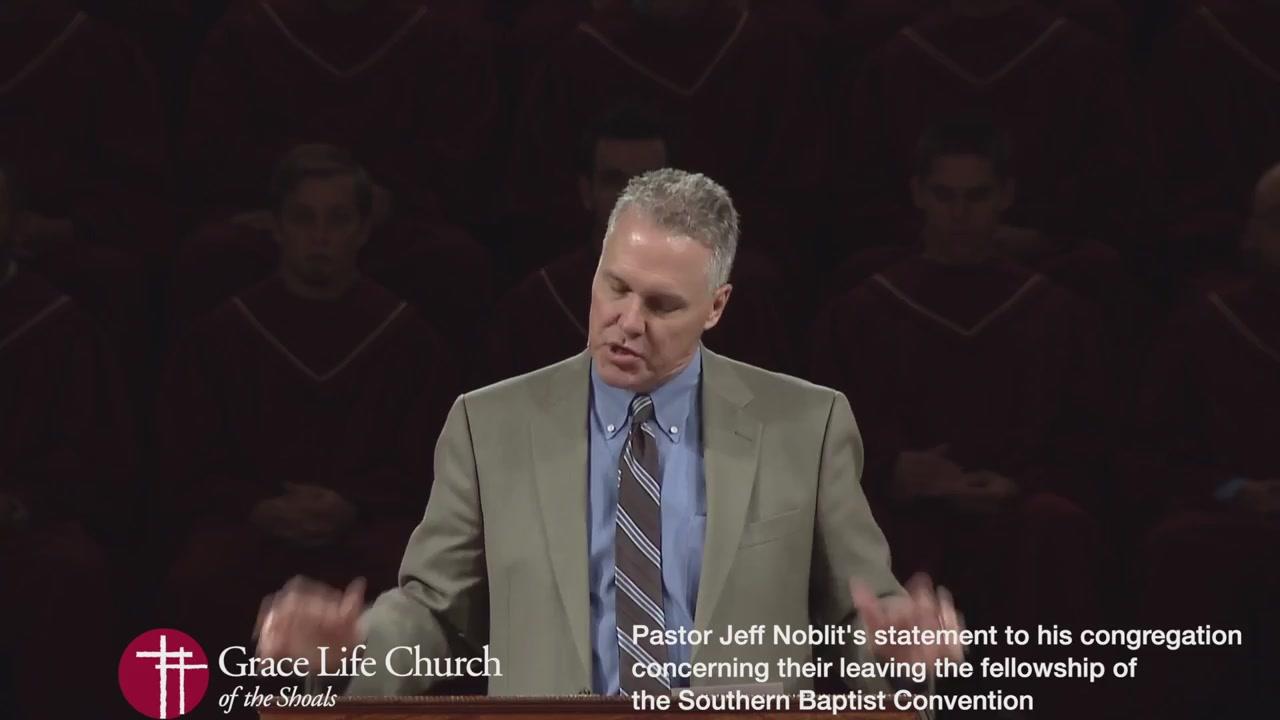
ago, Jeff Noblit of Grace Life Church announced that his church will be
resigning their affiliation with the Southern Baptist Convention. His
announcement was made to the church he shepherds, but it was also streamed. Due
to the streaming of the announcement, it spread quite fast to where I was asked
to watch it not long after. Only in this age of social media could a message
directed to a local church near the east coast find itself into the ears of a
pastor on the west coast. Due to the content of the video, it likely received wide
support from those who believe and spread the narrative that the SBC is
downgrading into theological liberalism, cultural Marxism, and feminist egalitarianism.
This widespread support comes from those both inside and outside the SBC. Some
are genuinely concerned about the faithfulness of their denomination. Others
are trolls just wanting to see the convention burn. I have encountered both
types on social media over this issue.
With that being
said, I feel compelled to respond to Pastor Nobilt indirectly in this blog.
Normally, I would not trouble myself. But his announcement had second and third
order effects. When some of my own church members and former members sent me
the video asking why we are supporting a godless denomination, it created fires
in my own ministry that needed quenching. Rather than give the same answer
dozens of times, I decided it would be easier just to write my thoughts about Pastor
Jeff’s announcement.
First, let me state
upfront that I think Jeff’s message was very sincere and reflective. I appreciate
the fact that he held on as long as he could before supporting the decision to
exit the SBC. I do not believe Pastor Jeff was intentionally being divisive. In
fact, I am convinced he is following his conscience—a conscience sanctified by
the Scriptures. Yet, I find myself in wide disagreement with him over his
stated reasons for leaving the SBC. Theologically, Jeff Noblit and I are very
much the same. We are soteriologically Calvinist. We believe in a plurality of equal
elders in terms of church polity. We both practice church discipline as articulated
by Matthew 18:15-20 and 1 Corinthians 5, among other texts. These very
convictions are the reason Jeff stated his church is leaving the SBC, because
in his experience, the SBC is opposed to these important biblical traits of a
healthy church. For obvious reasons, if Jeff’s concerns were true, Sovereign
Way Christian Church would have to exit the SBC too. Yet, we are not exiting
the SBC. And the reason is because I believe Jeff is wrong on most of the reasons
he gave.
In his narrative,
Jeff left me with the impression that his church could have been a major player
in SBC politics and position, but Grace Life was blackballed because their
fidelity to the biblical practice of church discipline, the biblical governance
of a plurality of elders, and the biblical soteriology, better known as the
doctrines of grace. It is certainly possible in his local association some of
this may be true. But Sovereign Way’s (SWCC) experience is quite opposite. I
helped plant this church in 2010 as a non-denominational church. From day one,
we were Reformed in our soteriology, we possessed a plurality of elders, and we
practiced church discipline. It was not until 2013 we decided to affiliate with
the SBC. Our local association was most helpful. They accepted us with open arms.
They knew we were Reformed, they knew we practiced plural eldership, and they knew
we practiced church discipline. These items did not hinder our affiliation. Since
we are a small church, the SBC was not going to gain vast financial resources
from us. If anything, we were going to cost them rather than be a gain. Despite
this, we quickly attained, and still possess, a good reputation with the staff
of the nearest SBC college and seminary. Our local association has partnered
with us multiple times since our affiliation.
In light of that,
it is truly difficult to argue the SBC as a whole possesses an animus against
biblical eldership, church discipline, and Calvinism. I completed by Master of
Divinity at Southern Baptist Theological Seminary in 2017, and in that context I
was presented with arguments in favor of plural eldership, Calvinism, and
church discipline. Keep in mind, this is the SBC’s first and most prominent
seminary. They would not be so if the SBC as a whole has an animus against
Grace Life’s faithful distinctive traits. On top of this, of the six
seminaries, four of them are either Calvinist or are trending in that
direction. The wrongly labeled “traditionalists” may take issue with this, but
as seminaries teach preachers how to exegete biblical text and how to preach
expositionally, this Calvinist trend is inevitable since it is most faithful to
the Bible. Some of the seminaries strongly support Biblical, or Nouthetic,
counseling, even assisting ACBC in providing training. Biblical Counseling is
entirely Calvinistic in its biblical understanding and presuppositions. Some of
the most widely known and celebrated para-church organizations that are affiliated
with the SBC, such as 9 Marks, are likewise Calvinist, possess plural
eldership, and practice church discipline. We can add to this that in 2008 the
messengers of the SBC voted favorably on a resolution titled, On Regenerate
Church Membership and Church Member Restoration, which was an affirmation
of the Matthew 18:15-20 process of church discipline. Even though it was hard
fought, if the denomination was overwhelmingly opposed to church discipline,
then the resolution would have never passed. Finally, when I survey many of the
heads of the SBC institutions, as well as members on the committees and boards,
far too many of them are Calvinist for one to credibly argue there is an
anti-Reformed animus that makes affiliation in the SBC difficult for Reformed
churches. In light of all these facts, it is impossible for me to accept Pastor
Jeff’s stated reasons for exiting. It does not represent the reality of the SBC
as a whole. If it did, then SWCC would be exiting too.
 Jeff continued his
message by bringing forward a few straws that “broke the camel’s back,” as he
put it. First was the rise in embracing and affirming Beth Moore’s ministry
within the SBC. I share Jeff’s concern and really have nothing to write. I
would simply say that it does not justify exiting the convention—at least not
at this point. The SBC is 47,000 churches in cooperation, and it takes time to
get the messengers from the majority of churches organized and galvanized over
issues like this. The majority of our messengers are biblically conservative
complementarians. They would not embrace Beth Moore’s violation of 1 Timothy
2:11-15. Jeff also brought up three prominent pastors that backed Paula White’s
ministry. Those three pastors should be ashamed of themselves, but three
pastors out of 47,000 churches hardly represents a denominational crisis. Baptists
prize local autonomy, and due to that, these three would have to deny the faith
in order to be forced out of the SBC.
Jeff continued his
message by bringing forward a few straws that “broke the camel’s back,” as he
put it. First was the rise in embracing and affirming Beth Moore’s ministry
within the SBC. I share Jeff’s concern and really have nothing to write. I
would simply say that it does not justify exiting the convention—at least not
at this point. The SBC is 47,000 churches in cooperation, and it takes time to
get the messengers from the majority of churches organized and galvanized over
issues like this. The majority of our messengers are biblically conservative
complementarians. They would not embrace Beth Moore’s violation of 1 Timothy
2:11-15. Jeff also brought up three prominent pastors that backed Paula White’s
ministry. Those three pastors should be ashamed of themselves, but three
pastors out of 47,000 churches hardly represents a denominational crisis. Baptists
prize local autonomy, and due to that, these three would have to deny the faith
in order to be forced out of the SBC.

Those previous two
issues are not likely the main point of concern for Jeff. He focused in on
Critical Race Theory as he referenced the now infamous Resolution 9. Jeff
claimed that the messengers voted to include Critical Race Theory and
Intersectionality (CRT/I) as tools to help us interpret the Bible. This is
patently false. I do not believe Jeff is trying to deceive anyone, but instead
this reflects a very careless reading of the resolution. It also reflects a
mindset that presently assumes the worst about the motives of resolutions
committee. It is simply not true that the SBC messengers voted that we should
include God-hating theories and ideologies to help us interpret the Bible.
There was nothing in the resolution about hermeneutics. To argue such either
demonstrates a careless reading, or it demonstrates it wasn’t read at all, and
instead is based on the uncritical acceptance of rumors and accusations.
Many people know
that I was the original author of the resolution. My original sought to denounce
the Marxist ideology behind CRT/I and to provide a means to hold accountable
anyone that tries to smuggle it into our denomination. The resolution committee
decided to focus more on a narrow definition of CRT/I rather than the broader
understanding of it. I wanted it declared as incompatible with biblical Christianity
due to the contemporary critical theory from which it is fueled. Instead, they
changed my broad focus to a narrow focus centered on utilizing CRT/I as analytical
tools in a social context. Just so we can all be clear, I will quote some of
the more controversial statements in Resolution 9 so we can determine exactly
what is being said. First look at the fourth WHEREAS:
WHEREAS, Evangelical
scholars who affirm the authority and sufficiency of Scripture have employed
selective insights from critical race theory and intersectionality to
understand multifaceted social dynamics; and
Please note there is nothing about hermeneutics (interpretation of
Scripture) in this statement. It simply says some faithful believers have used
selective (meaning very limited) insights from CRT/I to understand social
dynamics. Is that true? I assume it is. There is likely some orthodox believer
that took one of the few accurate observations from CRT, and used it to better
understand some social dynamic somewhere. That is the MOST that this statement
says. As expositional preachers, we strive to never overstate or understate a
text, but instead to properly understand and explain exactly what it means.
When that same process is applied here, the statement is not by any means
endorsing the use of CRT/I to interpret Scripture or order social affairs
within the church.
Next, look at the
seventh WHEREAS. It says:
WHEREAS, Critical race
theory and intersectionality alone are insufficient to diagnose and redress the
root causes of the social ills that they identify, which result from sin, yet
these analytical tools can aid in evaluating a variety of human experiences;
and
Again, what does it say? It directly says CRT/I are insufficient to
address the social ills they identify. These social ills result from sin,
something repudiated by the critical theory that drives CRT/I. After stating
CRT/I cannot accomplish their intended goal, the statement then again admits
that it sometimes makes accurate observations. It says CRT/I can aid in
evaluating a variety of human experiences. Does that sound like it is being
used to interpret Scripture? Does that sound like it is telling churches to
employ it within church social situations? No. I think you can see the pattern
here. Pastor Jeff did what many have done in their reaction to Resolution 9. He
and they are guilty of overstating what the resolution actually says. The
overstatements have been irresponsible, leading to the alarm of many and the unnecessary
division of many more.
The eighth WHEREAS
is often overlooked by those citing Resolution 9 to sound the alarm. It says:
WHEREAS, Scripture contains
categories and principles by which to deal with racism, poverty, sexism,
injustice, and abuse that are not rooted in secular ideologies; and
This clearly states that the Bible itself has the categories and
principles by which to deal with everything CRT claims to be concerned with.
This is a statement of the sufficiency of Scriptures. Added to this is the first
RESOLVED. It says:
RESOLVED, That the
messengers to the Southern Baptist Convention meeting in Birmingham, Alabama,
June 11–12, 2019, affirm Scripture as the first, last, and sufficient authority
with regard to how the Church seeks to redress social ills, and we reject any
conduct, creeds, and religious opinions which contradict Scripture; and be it
further
Does this sound like the resolution is telling SBC churches to
interpret the Scripture with CRT? Does it tell the churches to address social
dynamics in the church with intersectionality? No. It says the Scriptures are
the sufficient authority for these matters. Furthermore, it directly rejects
any position that contradicts Scripture. Since Critical Theology and CRT/I do
just that, they are repudiated by this resolution.
So that only
leaves the second RESOLVED statement. It says:
RESOLVED, That critical race
theory and intersectionality should only be employed as analytical tools
subordinate to Scripture—not as transcendent ideological frameworks; and be it
further
 This statement assumes that some aspects of CRT/I can be divorced
from the Contemporary Critical Theory that animates it, and if this is the
case, then it is possible for such aspects to be used in subordination to
Scripture. I disagree with this statement within the resolution. I see CRT/I
the same way the Association of Certified Biblical Counselors (of which I am a
certified counselor) sees secular psychology. Secular psychology gets some
observations right due to common grace. We can acknowledge where it gets things
right, and such accurate observations are sometimes helpful to us. Secular psychology,
however, is entirely incompatible with biblical Christianity due to the
worldview and presuppositions that animate it. Therefore, we do not seek to
integrate biblical and secular counseling, nor do we presume it is possible to
subordinate secular psychology to Scripture. The two are rivals. They are
enemies. The same is true of CRT/I and biblical Christianity. This statement in
the resolution opens the door for a Christian to analyze some social issue through
a CRT/I lens, and I think that is unwise. However, it does not apply this to interpretation
of the Scriptures (hermeneutics) or to social relationships in the church.
Furthermore, it denounces the transcendent ideological framework behind CRT/I.
This statement assumes that some aspects of CRT/I can be divorced
from the Contemporary Critical Theory that animates it, and if this is the
case, then it is possible for such aspects to be used in subordination to
Scripture. I disagree with this statement within the resolution. I see CRT/I
the same way the Association of Certified Biblical Counselors (of which I am a
certified counselor) sees secular psychology. Secular psychology gets some
observations right due to common grace. We can acknowledge where it gets things
right, and such accurate observations are sometimes helpful to us. Secular psychology,
however, is entirely incompatible with biblical Christianity due to the
worldview and presuppositions that animate it. Therefore, we do not seek to
integrate biblical and secular counseling, nor do we presume it is possible to
subordinate secular psychology to Scripture. The two are rivals. They are
enemies. The same is true of CRT/I and biblical Christianity. This statement in
the resolution opens the door for a Christian to analyze some social issue through
a CRT/I lens, and I think that is unwise. However, it does not apply this to interpretation
of the Scriptures (hermeneutics) or to social relationships in the church.
Furthermore, it denounces the transcendent ideological framework behind CRT/I.
 So at the worst,
the resolution assumes that some Christians can look at political and social
items through a narrow usage of CRT/I devoid of Critical Theory and in total
subordination of Scripture. To insinuate Resolution 9 says anything more than
this is a grossly inaccurate overstatement. This is why I made a video in an
attempt to demonstrate that the reaction against Resolution 9 was ultimately a
series of irresponsible overstatements. As the original author of a resolution
that was radically altered, I would have been irate had Resolution 9 actually
stated what its critics accuse it of. Had it been guilty of what Jeff Noblit
said it is, then I would be writing this in support of his decision. Instead, I
agree with R. Albert Mohler. The resolution should have said a lot more, but it
definitely could have said no less. This is why evangelicals who actually study
critical theory in order to refute it also do not present Resolution 9 in the
irresponsible, alarmist fashion that we see from others. For the most part,
those who denounce it as smuggling Marxism into the SBC repeatedly demonstrate
they likely do not even know what CT/CRT/I is.
So at the worst,
the resolution assumes that some Christians can look at political and social
items through a narrow usage of CRT/I devoid of Critical Theory and in total
subordination of Scripture. To insinuate Resolution 9 says anything more than
this is a grossly inaccurate overstatement. This is why I made a video in an
attempt to demonstrate that the reaction against Resolution 9 was ultimately a
series of irresponsible overstatements. As the original author of a resolution
that was radically altered, I would have been irate had Resolution 9 actually
stated what its critics accuse it of. Had it been guilty of what Jeff Noblit
said it is, then I would be writing this in support of his decision. Instead, I
agree with R. Albert Mohler. The resolution should have said a lot more, but it
definitely could have said no less. This is why evangelicals who actually study
critical theory in order to refute it also do not present Resolution 9 in the
irresponsible, alarmist fashion that we see from others. For the most part,
those who denounce it as smuggling Marxism into the SBC repeatedly demonstrate
they likely do not even know what CT/CRT/I is.
I understand the
concern of some people. The convention had a chance to denounce the Critical
Theory ideology as a whole, and that opportunity was missed. But it was not
missed because of a conspiracy or downgrade. Those who possess large platforms
should have reached out to the resolution committee members to see what their
rationale was. After all, that is the biblical thing to do. I have done so, and
I can tell you, the committee members are just as opposed to CRT/I as the rest
of us. They also see it on the whole as being incompatible with biblical
Christianity. Rather than jump to conclusions that assume the worse, people
should speak with them. And let me encourage you with this. I believe at
Orlando in 2020, we will get another resolution that will finally put this
issue to rest. Pray that this happens.
The final point I
would like to make is why I still think the SBC is the best option for faithful
Baptist churches. I do this as a plea of Jeff to remain with the SBC. In Paul’s
epistles, there was clear cooperation between independent churches as they
pooled resources and people to assist the impoverished churches in Judea.
Faithful churches, like the one at Philippi, and less faithful ones, like the
one at Corinth, still cooperated for this biblical purpose. Apparently this
kind of cooperation extended to Great Commission purposes too, as Paul expected
the Roman church to assist him in reaching Spain. With that said, a cooperation
of orthodox churches is always stronger and more capable of fulfilling the
Great Commission than a single church in isolation. In the Matthew 24:14, Jesus
said the end will only come after we reach every nation with the gospel. We
should all make this our churches’ number one priority.
 Applying this
concept of cooperation to the SBC, no other group of churches, nor any
individual church, even comes close to what the SBC accomplishes for the
kingdom. For example, the International Mission Board presently funds 3,678
missionaries all over the world. In 2018, 847 unreached people groups were
engaged by missionaries. In the same year, 13,898 new churches were planted outside
of the U.S. Amazingly, 77,605 people confessed Christ as Lord, of which 52,586
were baptized. The 3,000 plus missionaries are also effective at producing more
gospel ministers: 18,428 pastors were trained overseas and 85,362 indigenous
leaders received theological, pastoral, and church planter training. With this
kind of work being accomplished, our generation may at last finish the Great
Commission. It makes little sense to blow up the SBC because of rumors. Within
our own hemisphere, the North American Mission Board planted 624 new churches in
2018 and sent 3,600 chaplains into the military, prisons, hospitals, and
natural disasters. I am enabled to preach the gospel in a unique environment
because NAMB sends me to the Army. Finally, with four of the six seminaries
trending Reformed, it only means greater numbers of biblically sound pastors
are being produced and sent to the churches.
Applying this
concept of cooperation to the SBC, no other group of churches, nor any
individual church, even comes close to what the SBC accomplishes for the
kingdom. For example, the International Mission Board presently funds 3,678
missionaries all over the world. In 2018, 847 unreached people groups were
engaged by missionaries. In the same year, 13,898 new churches were planted outside
of the U.S. Amazingly, 77,605 people confessed Christ as Lord, of which 52,586
were baptized. The 3,000 plus missionaries are also effective at producing more
gospel ministers: 18,428 pastors were trained overseas and 85,362 indigenous
leaders received theological, pastoral, and church planter training. With this
kind of work being accomplished, our generation may at last finish the Great
Commission. It makes little sense to blow up the SBC because of rumors. Within
our own hemisphere, the North American Mission Board planted 624 new churches in
2018 and sent 3,600 chaplains into the military, prisons, hospitals, and
natural disasters. I am enabled to preach the gospel in a unique environment
because NAMB sends me to the Army. Finally, with four of the six seminaries
trending Reformed, it only means greater numbers of biblically sound pastors
are being produced and sent to the churches.
So for all these
reasons, I strongly disagree with many of the statements made by Pastor Jeff
Noblit. If Jeff reads this, please understand brother, I have nothing but great
respect for you. You have done more for the kingdom than I have, so I write
this critique with great trembling. If anything, I hope this persuades you to
stay with the SBC. We need more churches like yours to stay in the convention.
We are winning the fight, and the only way we will continue to win is if gospel-loyal
pastors like you stay committed to the SBC. CRT/I is a true threat, and it is incredibly
naïve to deny it. So I will continue to fight it until the SBC has repudiated
it at both the national and state level. The success of this depends first on
Christ, but second it depends on having many faithful churches take a lead in
the SBC. I pray that Pastor Jeff and those who feel as he does will perhaps see
what I am writing here and change their mind and support the ongoing
Conservative Resurgence from inside the denomination. Thanks for taking the
time to read this. God bless.

 There were also other factors caused him to think I might be a good person for the position of 2VP. The other factors include me being a Jewish believer in Jesus that pastors an ethnically diverse Gentile church in hostile California, while at the same time serving as a NAMB missionary in the United States Army Reserves as Chaplain (I presently hold the rank of Major). Furthermore, I served the church bi-vocationally for seven years, where I worked as a public high school teacher while I pastored SWCC nearly full time. So I understand small church dynamics within a post-Christian environment (CA) as well as the more and more common reality of bi-vocational shepherding. My experience in the Army also fashioned me to work well with those who hold positions different than my own. In future posts I will expand on how these various factors shaped me. Dr. Bolt and many others think the SBC should platform pastors that represent my kind of experience. I waited a few weeks after he asked me if he could nominate me. I prayed much and sought a lot of counsel. When it was all done, I agreed. I think Dr. Bolt is right. Quite often, pastors of large urban churches that give much to the CP are nominated for these positions. Most certainly, those pastors and their ministries are extremely important and benefit us all. The average SBC pastor and church, however, hardly resembles those who usually receive a platform within the SBC. Both kinds of pastors should have a seat at the proverbial table. If I get elected as 2VP, then we can rejoice in the fact that there is a place at the table for pastors like me. Stay tuned for more posts.